

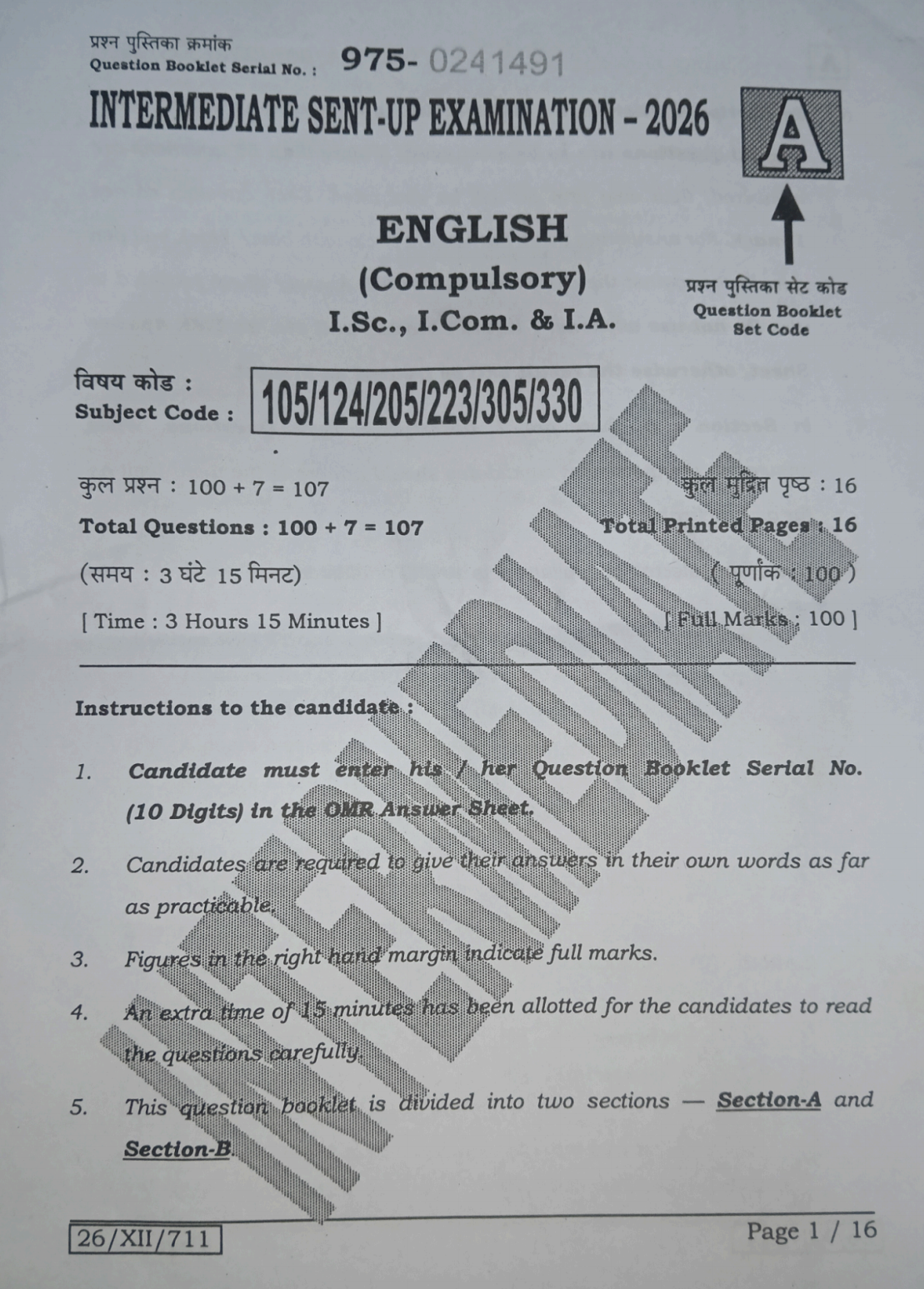
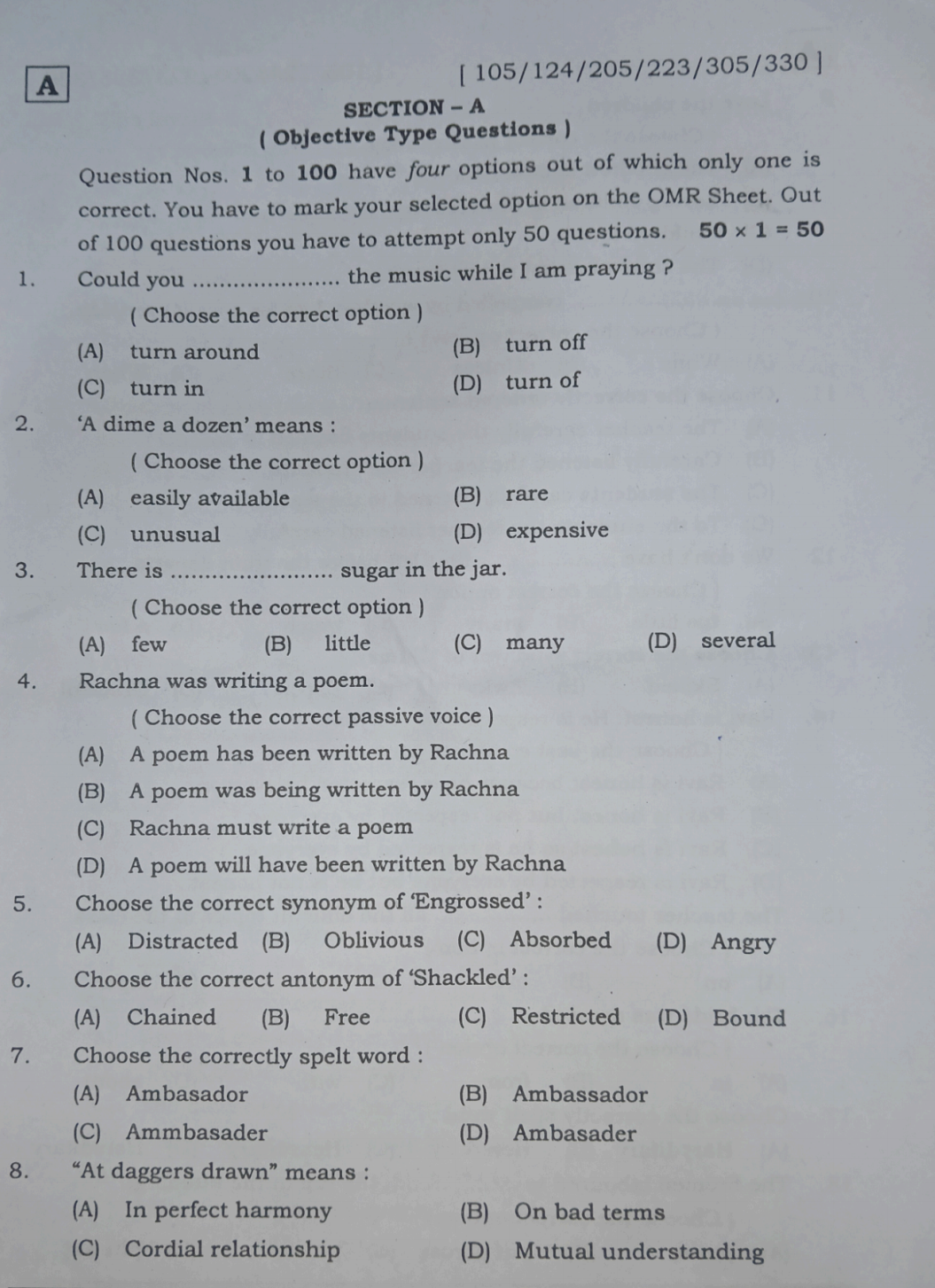
21 November Class 12th English Sent UP Exam 2026 Answer Key: बिहार बोर्ड 12वीं अंग्रेजी 21 नवंबर सेंट-अप परीक्षा का आंसर की, यहाँ से प्राप्त करें।
| WhatsApp channel follow |
SECTION – B
1. Write an essay on any one of the following in about 150–200 words.
(a) The Commercialization of Education
Answer:
Education is the most important part of human life. It helps us to become knowledgeable, responsible and good citizens. But nowadays, education has become a business. This is called the commercialization of education.
Many private schools and colleges charge very high fees from students. They give more importance to money than knowledge. Poor students cannot afford quality education because of high fees. Many educational institutions are interested only in making profits.
Education should not be treated as a business. Its main purpose is to develop the personality and character of students. Every child has the right to get a good education. The government should provide affordable and quality education to all.
Teachers should also focus on the overall development of students rather than money. Education must develop moral values, discipline and social responsibility.
In conclusion, education is a basic right, not a commodity for sale. We should make education affordable and accessible to everyone.
(b) Sustainable Development
Answer:
Sustainable development means development that meets the needs of the present generation without compromising the ability of future generations to meet their own needs.
It is very important for the future of our planet. Today, population growth, pollution, deforestation and overuse of natural resources have created many environmental problems. We are using natural resources very rapidly.
Sustainable development teaches us to use natural resources carefully. We should save water, electricity, forests and wildlife. We should plant more trees and use renewable sources of energy like solar and wind energy. We should also reduce pollution and avoid wasting resources.
The government and citizens must work together to protect the environment. Industries should adopt eco-friendly methods of production. People should use public transport and reduce plastic waste.
In conclusion, sustainable development is necessary for a safe and healthy future. We must protect nature and use resources wisely so that future generations can also enjoy a better life.
(c) Waste Management
Answer:
Waste management means the proper collection, treatment and disposal of waste materials. It is very important for keeping our environment clean and healthy.
Nowadays, waste is increasing rapidly due to population growth, industrialization and urbanization. Plastic, paper, food waste and other garbage create pollution. Improper disposal of waste causes many diseases and damages the environment.
We can manage waste by following the three principles: Reduce, Reuse and Recycle. We should reduce unnecessary consumption, reuse useful materials and recycle paper, plastic, glass and metals. Wet waste can be converted into compost. We should not throw garbage on roads, in rivers or in public places.
The government should provide proper dustbins and waste collection facilities. People should also be aware of their responsibilities.
In conclusion, waste management is necessary for a clean and healthy society. Every citizen should participate in keeping the surroundings clean. Proper waste management can make our environment safe for future generations.
(d) The Diversity of India
Answer:
India is a country of great diversity. People of different religions, languages, cultures, traditions and lifestyles live together here. That is why India is known as a land of unity in diversity.
India has many religions such as Hinduism, Islam, Christianity, Sikhism, Buddhism and Jainism. People speak different languages like Hindi, English, Bengali, Tamil, Telugu and many others. Every state has its own food, dress, festivals and traditions.
People celebrate different festivals such as Diwali, Eid, Christmas, Holi, Durga Puja and Gurpurab. India also has different geographical features, including mountains, rivers, deserts, forests and coastal areas.
Although people have different customs and traditions, they live together with mutual respect and cooperation. This diversity makes India culturally rich and beautiful.
In conclusion, unity in diversity is the greatest strength of India. We should respect every religion, language and culture and work together for the progress of our country.
(e) Gender Inequality
Answer:
Gender inequality means discrimination between men and women. It is a serious social problem in our society. Men and women should have equal rights and opportunities, but in many places women still face discrimination.
In some families, boys are given more importance than girls. Girls are sometimes denied proper education and freedom. Women also face discrimination in employment, salary and social life. This prevents the development of society.
Education is the best way to remove gender inequality. Every girl should get equal opportunities in education, employment and other fields. Parents should treat boys and girls equally. The government has also introduced many schemes to empower women.
Women have proved their abilities in education, science, sports, politics and business. They can achieve success in every field if they get equal opportunities.
In conclusion, gender equality is necessary for a developed society. We should respect women and provide equal rights to everyone. Both men and women must work together to build a strong and prosperous nation.
2. Explain any one of the following:
(a) “It was not that he was insane or imbecile or even that he could not read and write and count figures, ….”
Answer:
The given lines describe a person who was neither mad nor foolish. He was also not illiterate and could read, write and count figures. The writer wants to explain that the person’s problem was not due to a lack of intelligence or education. These lines highlight the difference between ordinary intelligence and practical understanding. A person may possess education and knowledge but still lack wisdom or the ability to understand certain situations.
(b) “When he got home, Seibei’s face was pale.”
Answer:
These lines describe Seibei’s condition when he returned home. His face had become pale because he was deeply upset and frightened. He had been very fond of collecting gourds, but his hobby had brought him trouble. The incident had made him worried about the consequences. These lines show Seibei’s innocence, fear and attachment to his hobby.
(c) “But I shall be told that it is neither numbers nor multiplicity of pleasures that make the glory of man.”
Answer:
In these lines, the writer expresses that the greatness of human life does not depend on the number of pleasures or material comforts. True human glory lies in noble thoughts, good qualities, wisdom and meaningful actions. A person becomes great through character, kindness and service to humanity, not merely through wealth or enjoyment.
(d) “When we speak of ‘the freedom of the press’, we usually mean freedom in a very technical and restricted sense—”
Answer:
These lines explain the meaning of freedom of the press. Freedom of the press means that newspapers and other media should have the right to express their opinions and publish news without unnecessary interference. However, this freedom also carries responsibility. The press should provide truthful information and should not spread false news or harm society. The writer emphasizes that freedom should be used responsibly.
3. Explain any one of the following:
(a) “But believe that I shall make
Speedier journeys, since I take
More wings and spurs than thee.”
Answer:
In these lines, the poet expresses his confidence in his ability to travel faster. He says that he has more wings and spurs than the person or object being addressed. These words suggest speed, energy and determination. The poet wants to show that imagination and human ambition can overcome ordinary limitations. The lines express confidence and enthusiasm.
(b) “Whispering neighbours, left and right,
Pluck us from the real delight.”
Answer:
In these lines, the poet describes how the interference of neighbours disturbs people’s happiness. The neighbours keep whispering and talking about others. Their unnecessary comments take people away from their real enjoyment and peace. The poet criticizes gossip and social interference. He suggests that people should avoid unnecessary criticism and enjoy life peacefully.
(c) “Sometimes whoever seeks abroad may find
Thee sitting careless on a granary floor.”
Answer:
These lines are taken from John Keats’s poem To Autumn. The poet describes Autumn as a season of abundance and prosperity. He says that a person may find Autumn sitting peacefully on the floor of a granary after the harvest. The poet personifies Autumn as a human being. These lines show the richness, beauty and peaceful atmosphere of the harvest season.
(d) “But must I confess how I liked him,
How glad I was he had come like a guest in quiet, to drink at my water-trough.”
Answer:
These lines are taken from Robert Frost’s poem A Prayer in Spring?
प्रश्न 3(a). “But believe that I shall make
Speedier journeys, since I take
More wings and spurs than thee.”
Answer:
These lines are taken from John Donne’s poem Sweetest Love, I Do Not Go. The poet tells his beloved not to feel sad because of his departure. He says that he will return quickly. Love gives him wings and spurs to travel faster than the sun. The poet expresses his deep love and affection for his beloved.
RPO
प्रश्न 3(b). “Whispering neighbours, left and right,
Pluck us from the real delight.”
Answer:
These lines are taken from W. H. Auden’s poem Now the Leaves Are Falling Fast. The poet says that the messengers of death are present everywhere. They remind human beings that death is inevitable and take away their happiness. The poet explains that human life is temporary and everyone has to face death one day.
Bihar Board Solutions+1
प्रश्न 3(c). “Sometimes whoever seeks abroad may find
Thee sitting careless on a granary floor.”
Answer:
These lines are taken from John Keats’s poem To Autumn. The poet describes Autumn as a season of plenty and prosperity. He imagines Autumn as a person sitting peacefully on the floor of a granary after the harvest. These lines express the beauty, richness and peaceful atmosphere of the autumn season.
Evidyarthi
प्रश्न 3(d). “But must I confess how I liked him,
How glad I was he had come like a guest in quiet, to drink at my water-trough.”
Answer:
These lines are taken from D. H. Lawrence’s poem Snake. The poet describes a snake that comes to drink water from his water-trough. The poet feels happy and honoured to see the snake as a peaceful guest. He likes the snake and allows it to drink water peacefully. These lines express the poet’s love, sympathy and respect for nature and living creatures.
प्रश्न 4. Write a letter to your father sharing your experiences on your first day at a new school.
उत्तर:
Examination Hall,
Patna.
Date: 20 November 2026
My dear Father,
I hope you are fine. I am also fine here. Today, I am writing this letter to share my experience of my first day at a new school.
I was very excited as well as nervous on my first day. The school building was very beautiful and spacious. The teachers were kind and helpful. I met many new students and made some friends. The principal welcomed me warmly. The classrooms were clean and well-equipped. I enjoyed my first day very much.
I hope to study well and make you proud.
Please convey my regards to mother.
Your loving son,
Rahul
प्रश्न 5. Answer any five of the following in about 40–50 words each.
(a) What were Lomov’s motivations for proposing to Natalia?
Answer: Lomov wanted to marry Natalia because he was already thirty-five years old and wanted to settle down. He thought that she was a good housekeeper, well-educated and not bad-looking. He also wanted a peaceful and regular family life.
(b) Why did Pearl S. Buck want to visit India?
Answer: Pearl S. Buck wanted to visit India because she had a deep interest in its people, culture and civilization. She wanted to understand Indian life, traditions and social conditions closely. She was attracted by the spiritual and cultural richness of India.
(c) Discuss the role of Florence in the short story ‘The Earth’.
Answer: Florence is an important character in the story ‘The Earth’. She is a hardworking and practical woman. She supports her family and plays an important role in maintaining the household. Her character represents the struggles and responsibilities of ordinary family life.
(d) Why has the poet kept “Creeds and Schools” at abeyance in ‘Song of Myself’?
Answer: In ‘Song of Myself’, Walt Whitman keeps creeds and schools at abeyance because he believes in independent thinking and personal experience. He does not want to follow fixed religious beliefs or educational systems blindly. He gives importance to nature, freedom and the individual soul.
(e) What does the poet think about beauty in the poem ‘An Epitaph’?
Answer: In the poem ‘An Epitaph’, the poet believes that physical beauty is temporary. A beautiful person may lose beauty with the passage of time. True beauty is associated with good qualities and noble character. The poem reminds us that outward appearance does not last forever.
(f) How can ‘Some corner of a foreign land’ be ‘Forever England’?
Answer: In the poem ‘The Soldier’, Rupert Brooke says that wherever an English soldier dies, that place becomes a part of England. His body gives the foreign land English qualities and memories. Thus, a corner of a foreign country becomes ‘Forever England’.
(g) What are the two sins the poet swore to save the fire from in ‘Fire-Hymn’?
Answer: The poet wishes to save fire from the two sins of pollution and misuse. He feels that fire is a sacred element and should not be treated carelessly. He expresses his respect for fire and wants to preserve its purity and dignity.
(h) What are the key elements of a dramatic structure?
Answer: The key elements of a dramatic structure are exposition, rising action, climax, falling action and resolution. These elements help develop the plot of a drama. They introduce the characters, create conflict, reach the highest point of tension and finally bring the story to an end.
(i) What has R. K. Narayan achieved through his social comedies?
Answer: R. K. Narayan has presented Indian society through humour, irony and satire in his social comedies. He has exposed social evils, human weaknesses and everyday problems. His works provide entertainment as well as a realistic picture of Indian life and human relationships.
(j) Name any four countries where English is used as a second language (L2).
Answer: Four countries where English is used as a second language are India, Nigeria, Singapore and the Philippines.
प्रश्न 6. Write the summary of any one of the following poems in about 100–120 words.
(i) My Grandmother’s House
Answer:
The poem ‘My Grandmother’s House’ is written by Kamala Das. In this poem, the poet remembers her grandmother and her old house. She spent a happy childhood in that house. Her grandmother loved her very much. After her grandmother’s death, the house became lonely and silent. The poet feels sad because she has lost the love and affection of her grandmother. She remembers the happy days of her childhood. She wants to return to that house to get the same love and care. The poem expresses love for grandmother, childhood memories, loneliness and emotional attachment to one’s home.
(ii) An Epitaph
Answer:
The poem ‘An Epitaph’ is written by Walter de la Mare. The poem describes a beautiful woman who is no longer alive. The poet remembers her beauty and charm. He says that she was once very beautiful, but now she is dead. Her physical beauty has disappeared with time. The poem reminds us that human beauty and life are temporary. Nobody can remain young and beautiful forever. Through this poem, the poet expresses the truth of death and the temporary nature of physical beauty.
(iii) Snake
Answer:
The poem ‘Snake’ is written by D. H. Lawrence. In this poem, the poet describes an incident in which a snake comes to drink water at his water-trough. The poet feels happy and considers the snake an honoured guest. However, his education and social beliefs tell him that snakes are dangerous. He takes a stick to attack it, but later feels guilty for his behaviour. He realizes that the snake is a beautiful and harmless creature. The poem teaches us to respect nature and all living creatures. It also highlights the conflict between natural feelings and social education.
प्रश्न 6 (b). Write the summary of any one of the following prose-pieces.
(i) Bharat is My Home
Answer:
The essay ‘Bharat is My Home’ is a speech delivered by Dr. Zakir Hussain. In this essay, he expresses his love and devotion towards India. He says that India is his home and all Indians are members of one family. He believes that education plays an important role in building the nation. Teachers and students must work honestly for the progress of the country. He also emphasizes the importance of democracy, national unity and moral values. Every citizen should serve the nation with dedication. He wants India to become a strong, peaceful and developed country. The essay teaches us patriotism, responsibility and national integration.
(ii) A Marriage Proposal
Answer:
‘A Marriage Proposal’ is a famous one-act play written by Anton Chekhov. The play is a humorous story about marriage. Lomov, a wealthy landowner, visits his neighbour Chubukov to ask for his daughter Natalya’s hand in marriage. Chubukov becomes very happy and calls Natalya. However, Lomov and Natalya start quarrelling over the ownership of Oxen Meadows. Later, they quarrel over their dogs. Lomov becomes nervous and faints. Chubukov finally manages to get them engaged. Even after the engagement, they continue arguing. The play presents human weaknesses, greed and foolish quarrels in a humorous way.
(iii) A Child is Born
Answer:
‘A Child is Born’ is a prose piece by Germaine Greer. It deals with the birth of a child and the experiences of motherhood. The writer discusses how different societies treat pregnancy, childbirth and motherhood. She explains that the birth of a child is a natural process, but social customs and traditions influence the experience of women. The essay highlights the physical and emotional changes experienced by a mother. It also describes the importance of family and social support during childbirth. The writer encourages us to understand motherhood with sympathy and respect. The lesson gives us knowledge about different cultural practices related to childbirth.
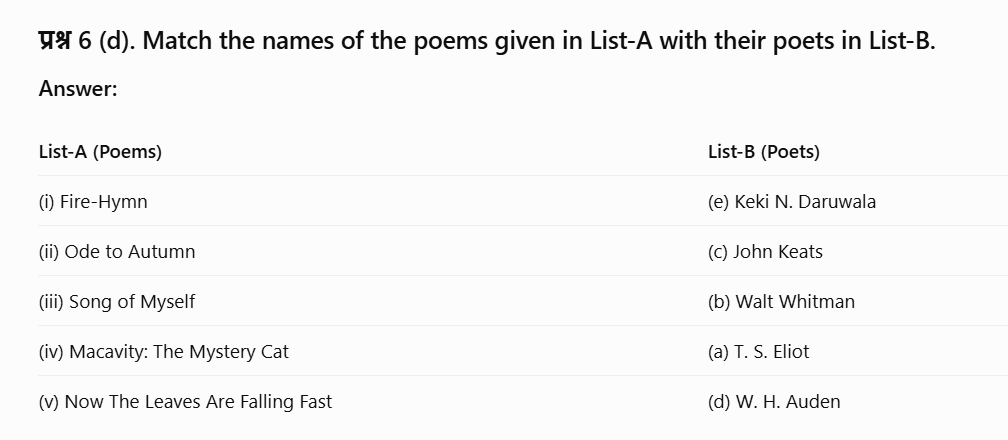
प्रश्न 6 (c). Write a short note on American Drama.
Answer:
American Drama is an important part of English literature. It developed mainly during the nineteenth and twentieth centuries. It deals with American society, culture, family life and human problems. Famous American dramatists include Eugene O’Neill, Tennessee Williams, Arthur Miller and Edward Albee. Their plays discuss social conflicts, human relationships, loneliness and the struggle for success. American drama uses realistic characters and situations. It has made a valuable contribution to world literature.
अथवा
प्रश्न 6 (c). Briefly describe the dialects of Middle English.
Answer:
Middle English was spoken in England from about 1100 to 1500. It had five main dialects: Northern, Southern, East Midland, West Midland and Kentish. These dialects differed in pronunciation, vocabulary and grammar. The East Midland dialect became very important because London was situated in this region. Geoffrey Chaucer used this dialect in his famous work ‘The Canterbury Tales’. Later, it became the basis of Modern Standard English.
अथवा
प्रश्न 6 (c). Discuss the contributions of 18th century grammarians to the English language.
Answer:
The eighteenth-century grammarians played an important role in standardizing the English language. They tried to establish fixed rules of grammar, spelling and pronunciation. They wrote grammar books and dictionaries to make English more systematic. Robert Lowth wrote an influential English grammar book. Samuel Johnson published his famous dictionary in 1755. These grammarians helped to improve the correctness, uniformity and standard use of English. Their work greatly influenced modern English.
प्रश्न 6 (e). Translate any five into English.
(i) तैराकी एक अच्छा व्यायाम है।
Answer: Swimming is a good exercise.
(ii) सीमा सितार बजाना सीख रही है।
Answer: Seema is learning to play the sitar.
(iii) किसान अपने खेतों से प्रेम करते हैं।
Answer: Farmers love their fields.
(iv) मोहन कल दिल्ली जायेगा।
Answer: Mohan will go to Delhi tomorrow.
(v) मेरा विवाह हो चुका है।
Answer: I am married.
(vi) तुमने दीवार पर क्यों थूका?
Answer: Why did you spit on the wall?
(vii) वाह! भारत मैच जीत गया।
Answer: Hurrah! India has won the match.
(viii) कृपया दरवाजा बंद कर दें।
Answer: Please close the door.
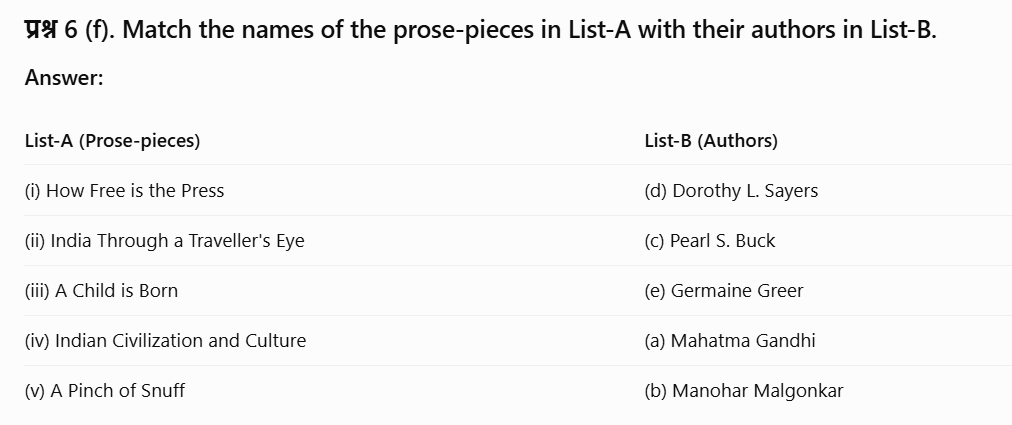
प्रश्न 7. Read the passage carefully and answer the questions that follow.
(a) Name two trees, other than pines and oaks, that grew in the quiet forest.
Answer: Olives and sycamores were the two trees that grew in the quiet forest.
(b) What did the oak tree often boast about?
Answer: The oak tree often boasted about its strength.
(c) How did the trees help the flowers during the storm?
Answer: During the storm, the trees spread their arms wide and protected the delicate flowers from the strong winds.
(d) What did the rose say to the trees after the storm?
Answer: The rose thanked the trees and said, “Without your strength, we would not have survived.”
अथवा (OR)
Write a precis of the following passage and give a suitable title.
Title: Biodiversity of India
Precis:
India is one of the most biodiverse countries in the world. It has different climates, landscapes and ecosystems, from the Himalayas to coastal plains and forests to deserts. India is home to many plants and animals, including tigers, elephants and lions. It has over 45,000 plant species and 90,000 animal species. The Western Ghats and Sundarbans are important biodiversity hotspots. India’s biodiversity supports life and provides livelihood to millions of people. Therefore, it is a great natural treasure.
Some important link:-
| 21 November 12th English Objective Answer Key | Download |
| 21 November 12th English Subjective Answer Key | Download |
| WhatsApp channel | follow |
| Telegram channel | follow |